
The ruble has recouped most of its losses and become the top-performing currency globally. It continues to gain and is up 60 per cent against the US dollar from its lows in the first week of March. The ruble appreciated to 83 to the dollar intraday on Tuesday against a record low of 139 on March 7.
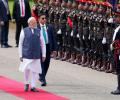
'Granting the country's highest civilian honour to Prime Minister Modi was surprising as it indicated the government was going out of its way to have India as a close partner.'

Two 'very smart' leaders of India and Pakistan decided to end last month's conflict that could have turned into a nuclear war, United States President Donald Trump said after holding a rare luncheon meeting with Pakistan army chief Field Marshal Asim Munir at the White House.

The Israel-Iran conflict has entered a 'decisive phase' after the United States bombed three major Iranian nuclear sites Sunday morning, feel strategic affairs experts with some of them arguing it was Washington, DC's 'responsibility' to not get involved in the military standoff.

Finance Minister Nirmala Sitharaman on Wednesday said the country's economic growth remains a priority for the government, as inflation has come down to a manageable level. Job creation and equitable distribution of wealth remain the other focus areas, she said at India Ideas Summit. "Some of course are red-lettered (priorities), some may not be. Red-lettered ones would of course be jobs, equitable wealth distribution and making sure India is moving on the path of growth.
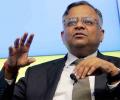
India is well positioned to continue to be the fastest-growing major economy next year, which may mark the lowest global growth since the millennium began barring the pandemic and the global financial crisis, according to Tata Sons chairman N Chandrasekaran. In his New Year message to around 9.35 lakh employees of the Tata Group, he said increasing consumption, consumer confidence and investment will support India's growth story although the global environment has several risk factors, including the energy crisis in Europe, the battle to contain inflation to avoid recession, and ongoing geopolitical conflicts. "Post-pandemic, India opened up, and we have returned to living our daily lives normally, in a year that saw the nation turn 75 years old.

The cost of living crisis is the biggest short-term risk the world is facing, while the failure of climate mitigation and climate adaptation is the largest long-term concern, the World Economic Forum said on Wednesday. Releasing its annual Global Risks report in London ahead of its Davos summit next week, the WEF also said geopolitical rivalries and inward-looking stances will heighten economic constraints and further exacerbate both short- and long-term risks. The Global Risks 2023 report, drawing on views of over 1,200 experts, policy-makers and industry leaders from across the world, also urged countries to work together to avoid 'resource rivalries'.
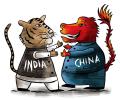
The International Monetary Fund (IMF) has said India and China will account for half of the global economic growth in 2023, as the multilateral agency retained its growth forecast for Asia's third-largest economy for 2023-24 (FY24). "India remains a bright spot. Together with China, it will account for half of global growth this year, versus just a tenth for the US and euro area combined," the IMF said in its latest update to the biannual World Economic Outlook. Growth in India is set to decline from 6.8 per cent in 2022 (FY23) to 6.1 per cent in 2023 (FY24) before picking up to 6.8 per cent in 2024 (FY25), the global lender said while citing "resilient domestic demand despite external headwinds".
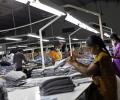
After experiencing an 11 per cent contraction in exports in 2023-24 (FY24) due to a dip in exports for 10 consecutive months from April to January, the Tiruppur textile industry is back on track in 2024-25 (FY25). The cluster, which contributes 55 per cent of the country's total knitwear exports, posted a 13 per cent increase in the first five months of this financial year (FY25), with August seeing a 22 per cent rise - the highest in over two years.

Carter was in politics, but not a politician, certainly not a transactional politician, points out Shreekant Sambrani.

Initially, the industry thought jatropha could be grown on wasteland, without irrigation. They got it wrong, as good care is required for at least three years of the total plant life of 40-45 years, in which moderate irrigation is also required.
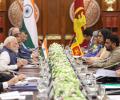
Prime Minister Narendra Modi received a tri-services ceremonial welcome in Colombo, Sri Lanka, marking the first time such an honor has been bestowed upon a foreign leader. The welcome took place at the historic Independence Square, the venue for national day celebrations. Modi's visit comes as Sri Lanka shows signs of recovery from a recent economic crisis, with India playing a significant role in providing assistance. During the visit, both leaders are expected to discuss a range of issues, including defense cooperation, energy, and digital initiatives.

At a virtual press conference to launch the report, Inger Anderson, Executive Director, United Nations Environment Programme, said, "Climate change is here and now. No one is safe. Despite warnings from so many years, the world did not listen. We need to act now. Reducing greenhouse gas emissions will not only limit climate change but also reduce air pollution."
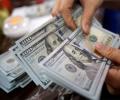
In response to the panic triggered by Trump's trade policies, the RBI net sold approximately $43 billion in the second half of FY25 to curb volatility, as the rupee plunged to a low of 87.95 per dollar in February this year.
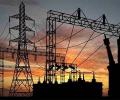
In a year when the country produced record coal, rains hit movement of the fuel from mines to power generation units, impacting power generation in many states, including Gujarat, Punjab, Rajasthan, Delhi and Tamil Nadu.

Indian economy is in a sweet spot, with a mix of solid growth and moderating inflation, Moody's Ratings said, forecasting a 7.2 per cent GDP growth in the 2024 calendar year and 6.6 per cent in the next. In its Global Macro Outlook 2025-26, the rating agency said the global economy has shown remarkable resilience in bouncing back from supply chain disruptions during the pandemic, an energy and food crisis after the Russia-Ukraine war began, high inflation and consequent monetary policy tightening.

The world is in a state of crisis and it is difficult to predict how long this state of instability will last, Prime Minister Narendra Modi said on Thursday referring to various global challenges arising out of conflict, war and terrorism among others. In his opening remarks at the Voice of Global South virtual summit, Modi flagged concerns over rising prices of food, fuel and fertilisers, economic impact of the COVID-19 pandemic as well as natural disasters driven by climate change. "We are meeting as a new year dawns and brings new hopes and new energy," Modi said.
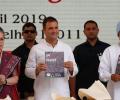
'Mrs Gandhi had nothing to do in the day-to-day working of Dr Singh's government.' 'People say Mrs Gandhi's office used to give orders, which is nonsense.'

Kakar, a lawmaker belonging to Balochistan Awami Party (BAP), will lead a caretaker government until a new election later this year.

India's economy is likely to grow by 6.5 per cent in the current and the next financial year, an EY report said, attributing lower than anticipated expansion in the September quarter to fall in private consumption expenditure and gross fixed capital formation. Real GDP growth eased to a seven-quarter low of 5.4 per cent in July-September -- the second quarter of the current 2024-25 fiscal year.
India's jugalbandhi with coal and clean energy is coming unstuck, neither achieving adequate renewable generation nor ensuring sufficient coal-fired power in the quest to become a $5-trillion economy. Six months have elapsed since Prime Minister Narendra Modi announced an ambitious climate agenda for India at COP26 at Glasgow. The net zero emissions target by 2070 is a distant one, but there are nearer-term plans to meet 50 per cent of energy demand with renewables by 2030 by increasing capacity to 450 Gw. A cursory look at the balance sheet of India's climate progress since November reveals ponderous progress towards meeting the renewables target even as the country is scrambling to expand coal-fired generation in the face of a power crisis.

Russia has welcomed India's decision to not support the price cap on Russian oil announced by G7 and its allies and offered it cooperation on leasing and building large-capacity ships to overcome the ban on insurance services and tanker chartering in the European Union and Britain to continue buying discounted oil. The offer came as Russian Deputy Prime Minister Alexander Novak held a meeting with the Indian Ambassador to Moscow, Pavan Kapoor, on Friday. "The Deputy Prime Minister welcomed India's decision not to support the price cap on Russian oil, which was imposed on December 5 by the G7 countries and their allies," the Russian foreign ministry said in a statement.

Modi called business communities and governments to work together to ensure usage of ethical AI as "we have to sense the potential disruptions in different sectors. This problem has to be solved under the global framework."

Unprecedented bribery charges, farewells, separation, failed union, monumental mergers and record-breaking IPOs, along with a healthy dose of online happenings in the form of spat and lessons in customer care, corporate India saw it all in 2024.
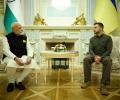
Ukraine and Russia need to engage with each other to find a solution to the ongoing conflict between them, India said on Friday after Prime Minister Narendra Modi held wide-ranging talks with President Volodymyr Zelenskyy in Kyiv under the shadow of the raging war.

Prime Minister Modi is attending the G7 summit, to be held on June 26 and 27, following an invitation by German Chancellor Olaf Scholz.

Moody's Investors Service on Wednesday raised India's economic growth estimate for 2023 to 5.5 per cent from 4.8 per cent pegged earlier, on the back of a sharp increase in capital expenditure in the Budget and a resilient economic momentum. It however revised downwards India's growth estimate for 2022 to 6.8 per cent from 7 per cent pegged in November last year. In its February update to Global Macro Outlook 2023-24, Moody's raised the baseline 2023 real growth projections "meaningfully" for several G20 economies, including the US, Canada, the Euro area, India, Russia, Mexico, and Turkiye, accounting for a stronger end to 2022.
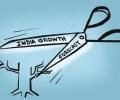
The International Monetary Fund (IMF) on Tuesday cut its projection of India's economic growth in 2022 to 6.8 per cent, as it joins other global agencies that have trimmed forecasts. The IMF had in July projected a gross domestic product (GDP) growth of 7.4 per cent for India in the fiscal year that started in April 2022. Even that forecast was lower than 8.2 per cent projected in January this year. India had grown at 8.7 per cent in 2021-22 fiscal (April 2021 to March 2022).

The leaders also noted the "negative impacts" of the war in Ukraine with regard to global food and energy security, especially for developing and least-developed countries.

Households are likely to remain the primary net lenders to the economy in the coming decades.

India's negotiating posture at the multilateral negotiations should be aligned with a significantly transformed development strategy domestically.' 'The positions the country takes at the negotiations will then carry credibility, says Shyam Saran, former foreign secretary and India's chief negotiator on Climate Change 2007-2010.
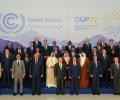
The overwhelming feeling at the end of COP 27 was that despite decades of meetings and landmark accords, like the Paris Agreement, the world was still not doing enough to slow the climate crisis, observes Ambassador T P Sreenivasan.

Emission norms for automobile industry should be tightened.
European Union steel prices hit their lowest since 2004

The Indian economy recovered from the Covid-induced downturn during 2022 and is poised for further improvement in the coming quarters though downside risks emanating from geopolitical tensions, strengthening dollar and elevated inflation will continue. The positive trajectory in the growth trend and improved fundamentals will help the nation in neutralising the impact of global headwinds which are expected to have a bearing on the country's exports in the months to come. The challenges before the government and the Reserve Bank in the new year would be to arrest inflation, check declining value of rupee against US dollar and promote private investment and growth, with a view to ensure that the country remains one the fastest growing major economies of the world.
A looming global shortage of diesel in Europe presents India with more than one opportunity to profit from strong margins. A shortage of the fuel, a key contributor to inflation, has been exacerbated by the conflict in Ukraine, and western sanctions on Russian fuel supplies. The slowdown in natural gas supply means the West needs diesel to heat their homes this winter.

President Droupadi Murmu on Tuesday said cyberattacks have emerged as a major threat to national security and the civil services and armed forces must join hands to create a secure nationwide system capable of thwarting them.

Major General S C N Jatar, who passed into the ages on Monday night, thwarted anti-national forces at the peak of the Assam agitation. Colonel Anil A Athale (retd) salutes this officer and gentleman.
Brent crude oil prices may rise to $110 a barrel in 2023, up nearly 33 per cent from the current levels, said analysts at Morgan Stanley, in a recent note. This is, however, lower than the peak level of nearly $127 touched earlier in 2022 as geopolitical concerns took centre stage amidrising demand. "Looking ahead, Brent oil price growth will decelerate even more in the coming quarters. "This comes even as our global oil strategist expects a rise in oil prices back to $110 a barrel by the second half of 2023.

Sukanya Verma raises a toast to the top female performers of 2024.
